
Testing laboratory and consultancy · Granges-Paccot

Book a call

Directive 2006/42/EC · Regulation (EU) 2023/1230

CE marking of machinery

The CE marking of a machine attests that it meets the essential health and safety requirements of the Machinery Directive 2006/42/EC, replaced on 20 January 2027 by the Machinery Regulation (EU) 2023/1230. Säfeli supports you from risk assessment to safety functions, testing and the technical file, through to the EU declaration of conformity that you sign.

Regulation (EU) 2023/1230 applies
20.01.2027
Risk assessment
EN ISO 12100
Safety functions
PL · SIL
Retention of the technical documentation
10 years

Who it is for

You design, integrate or modify machinery

  • Builders of special-purpose machinery

    Every machine is unique. We carry out the risk assessment and compile the technical file machine by machine, at the pace of your project.

  • Series machinery manufacturers

    A solid technical file, reusable from one version to the next, and monitoring of the standards for your machine family.

  • Integrators of lines and robot cells

    Assemblies of machinery, partly completed machinery, robots: we clarify who is the manufacturer of what and what each declaration must contain.

  • Operators who modify a machine

    A modification can make you the manufacturer. We assess whether it is substantial and what needs to be redone.

Our services

CE conformity of your machine, step by step

From the first risk assessment to the EU declaration of conformity, with testing carried out by the engineers who follow your project.

Säfeli engineer analysing the danger zone of a machine with the manufacturer
EN ISO 12100

Machinery risk assessment

We carry out the risk assessment using the EN ISO 12100 method: limits of the machine, identification of hazards over the whole life cycle, risk estimation and risk evaluation, then risk reduction in three steps (inherently safe design, safeguarding and complementary protective measures, information for use).

What you receive

  • Documented risk assessment
  • Justified risk reduction measures
  • List of safety functions and their PLr
  • List of applicable standards

References

  • EN ISO 12100:2010
  • ISO/TR 14121-2
Risk assessment in detail
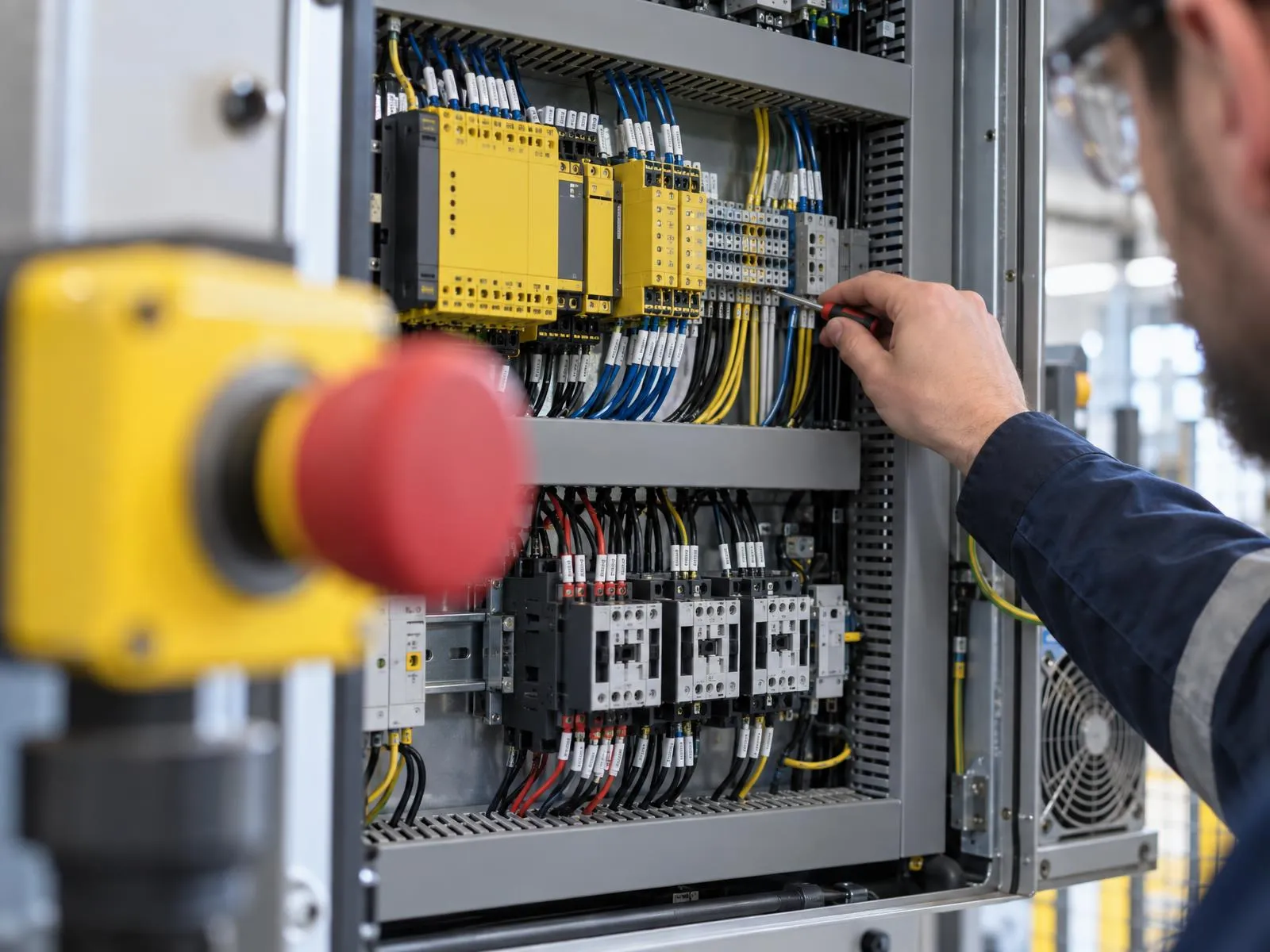
Machine control cabinet with safety relays and emergency stop
EN ISO 13849 · EN IEC 62061

Safety functions: PLr, PL and SIL

Emergency stop, guard interlocking, light curtain, reduced speed: for each safety function, we determine the required performance level (PLr), check the architecture and components, calculate the PL achieved (EN ISO 13849-1) or the SIL (EN IEC 62061) and prepare validation to EN ISO 13849-2.

What you receive

  • Specification of the safety functions
  • Calculation of the PL or SIL achieved
  • Validation plan and report
  • Review of electrical and fluid power diagrams

References

  • EN ISO 13849-1:2023
  • EN ISO 13849-2:2012
  • EN IEC 62061:2021
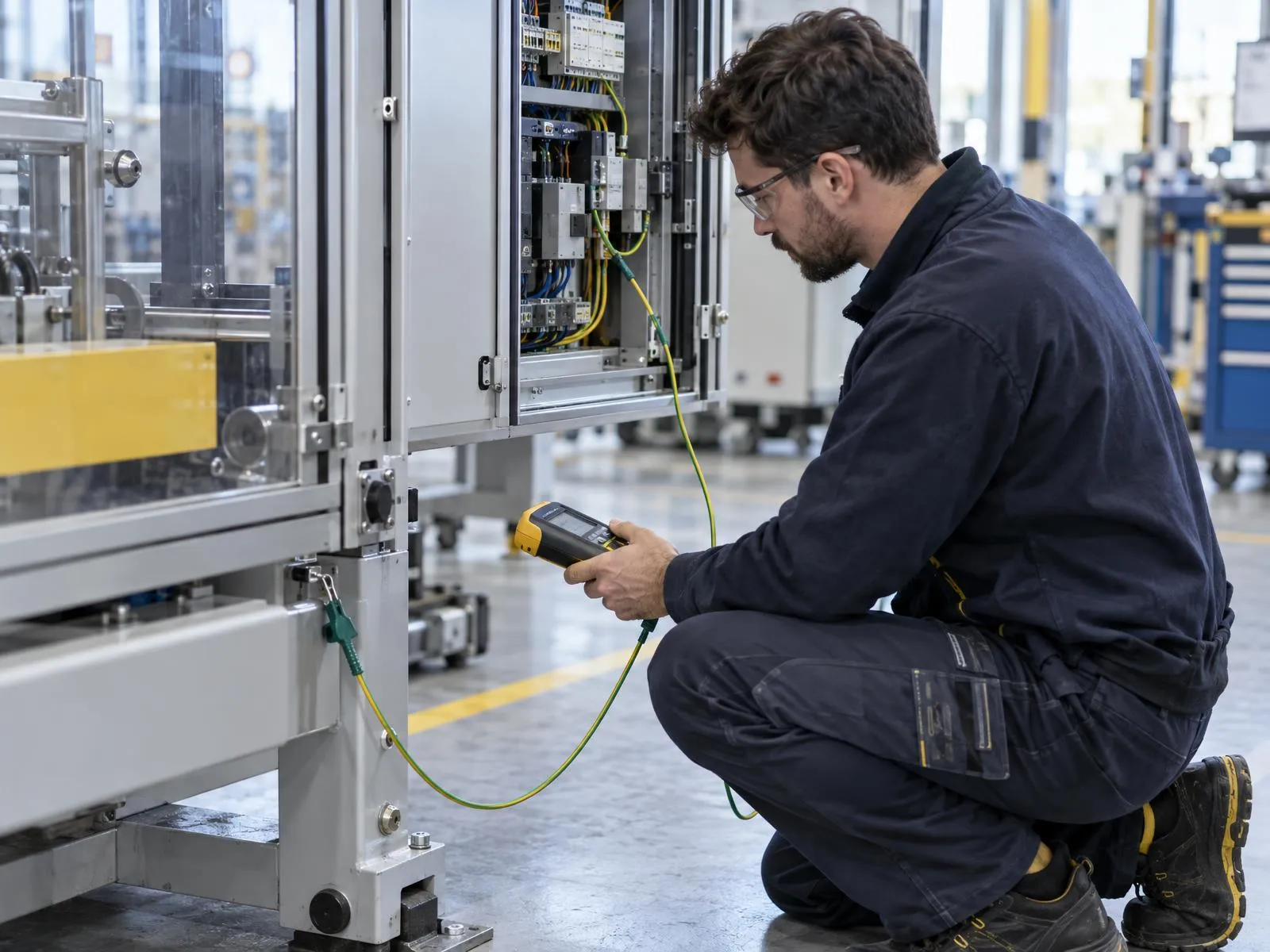
Säfeli engineer measuring the protective conductor continuity of a machine
EN 60204-1 · EMC

Testing on the machine

We verify the electrical equipment to EN 60204-1 and carry out the tests that demonstrate conformity: continuity of the protective bonding circuit, insulation resistance, voltage tests, residual voltages and functional tests of the safety functions. Where necessary, we also carry out the EMC tests. Tests take place on the machine, at your premises, or in our laboratory in Granges-Paccot.

What you receive

  • Test reports
  • Review of the diagrams and the control cabinet
  • Validation of the safety functions
  • EMC tests for industrial environments

References

  • EN 60204-1:2018
  • EN IEC 61000-6-2:2019
  • EN IEC 61000-6-4:2019
Our electrical safety testing
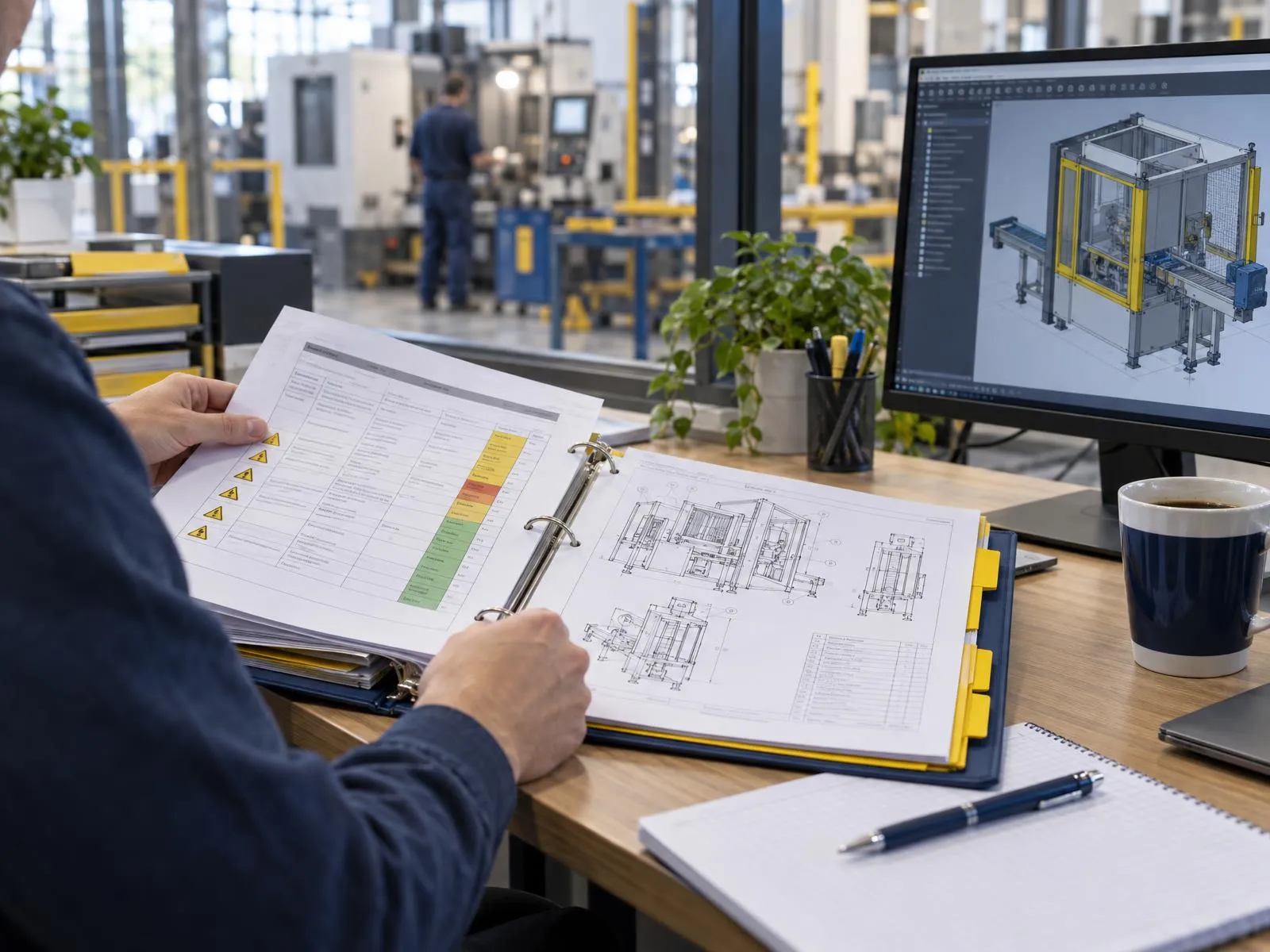
Open machinery technical file with risk assessment and drawings
Annexes IV and V

Technical file, instructions and EU declaration

We compile the technical documentation required by the Regulation (Annex IV): description, drawings, risk assessment, standards applied, test reports and instructions for use. We prepare the EU declaration of conformity (Annex V, Part A) or, for partly completed machinery, the EU declaration of incorporation (Annex V, Part B) and the assembly instructions (Annex XI).

What you receive

  • Complete technical file
  • Instructions for use, paper or digital
  • Rating plate and marking
  • EU declaration of conformity or incorporation, ready to sign

References

  • Regulation (EU) 2023/1230, Article 10
  • Annexes IV, V and XI
Our CE marking support

Also

Machinery Regulation

Regulation (EU) 2023/1230: what changes on 20 January 2027

The Regulation replaces the Machinery Directive 2006/42/EC. Directly applicable in all Member States, it retains most of the requirements and adds new ones. A machine placed on the market from 20 January 2027 must comply with it.

  1. 29.06.2023Publication in the Official Journal of the EU
  2. 19.01.2027Last day of Directive 2006/42/EC
  3. 20.01.2027Regulation (EU) 2023/1230 applies
  • Six high-risk categories

    Annex I, Part A, lists six categories, including vehicle servicing lifts and safety components with machine learning, which require conformity assessment by a third-party body.

    Annex I, Part A · Article 25
  • Cybersecurity

    Protection against corruption, and control systems designed to withstand reasonably foreseeable malicious attempts.

    Annex III, 1.1.9 and 1.2.1
  • Substantial modification

    The concept is now defined. Anyone who substantially modifies a machine is considered its manufacturer.

    Article 3, point (16) · Article 18
  • Digital instructions

    The instructions for use may be supplied in digital format. If the user requests it at the time of purchase, a paper version is supplied free of charge within one month.

    Article 10(7)
  • Self-evolving behaviour

    Machinery and safety components that use machine learning for safety functions are expressly covered.

    Annex I, Part A, points 5 and 6
  • Technical documentation

    To be kept for at least ten years. The authorities may request the source code or programming logic, on a reasoned request.

    Article 10(3)

Source: Regulation (EU) 2023/1230, OJ L 165, 29.6.2023, as corrected in OJ L 169, 4.7.2023 (date of application).

Machinery cybersecurity

Connected machinery: two legal acts to comply with

The Machinery Regulation requires the machine to withstand malicious attempts that could create a hazardous situation (Annex III, 1.1.9 and 1.2.1). If it contains connected digital elements (remote access, updates, cloud connection), the Cyber Resilience Act also applies: reporting obligations since 11 September 2026, the whole Regulation from 11 December 2027.

Sources: Regulation (EU) 2023/1230, Annex III; Regulation (EU) 2024/2847, Articles 14 and 71

Standards

The main machinery safety standards

Type A standards set out the principles, type B standards deal with one safety aspect (B1) or one type of safeguard (B2), type C standards with a family of machines. Where a type C standard exists, it takes precedence over type A and B standards.

TypeStandardScope
AEN ISO 12100:2010General principles for design, risk assessment and risk reduction
B1EN ISO 13849-1:2023Safety-related parts of control systems: design (PL)
B1EN ISO 13849-2:2012Validation of safety-related parts of control systems
B1EN IEC 62061:2021Functional safety of control systems (SIL)
B1EN 60204-1:2018Electrical equipment of machines
B1EN ISO 13857:2019Safety distances for upper and lower limbs
B1EN ISO 13855*Positioning of safeguards with respect to approach speeds
B1EN ISO 14118:2018Prevention of unexpected start-up
B1EN ISO 4413:2010 · EN ISO 4414:2010Hydraulic and pneumatic fluid power
B2EN ISO 14120:2015Fixed and movable guards
B2EN ISO 14119*Interlocking devices associated with guards
B2EN ISO 13850:2015Emergency stop function
CEN ISO 10218-2*Industrial robots: applications and robot cells
TSISO/TS 15066:2016Collaborative robots (technical specification, not harmonised)
EMCEN IEC 61000-6-2:2019 · EN IEC 61000-6-4:2019Immunity and emissions in industrial environments
CyberIEC 62443 series · ISO/TR 22100-4:2018Cybersecurity of industrial automation and its link with machinery safety

* Recent edition or under revision: we check the edition applicable to your project. Standards remain voluntary; applying a harmonised standard whose reference is published in the Official Journal of the EU gives a presumption of conformity with the requirements it covers (Regulation (EU) 2023/1230, Article 20). The harmonised status of each edition must be checked in the OJEU.

Product status

Machinery, partly completed machinery or assembly of machinery?

The first question to settle: it determines which documents must be produced and who signs them.

  • Machinery

    It performs a specific application on its own. You affix the CE marking and sign the EU declaration of conformity.

    Annex V, Part A
  • Partly completed machinery

    It cannot perform a specific application on its own and must be incorporated into a machine, for example a robot supplied without a tool. No CE marking: an EU declaration of incorporation and assembly instructions.

    Annex V, Part B · Annex XI
  • Assembly of machinery

    Several machines or partly completed machines arranged and controlled to function together. Whoever builds the assembly is responsible for it and CE marks it as a whole.

    Article 3 · Article 18

Existing machinery

Substantial modification: do you become the manufacturer?

Converting a machine after it has been placed on the market or put into service can make you the manufacturer, with all the obligations of CE marking. Three questions settle it.

  1. The physical or digital modification was not foreseen by the manufacturer?

  2. It affects safety: a new hazard or an increased existing risk?

  3. It requires adding guards that modify the control system, or stability or strength measures?

  4. Three times yes: substantial modification. You become the manufacturer: assessment, technical file, declaration and CE marking.

One answer is no: no substantial modification. Document the assessment that demonstrates this.Regulation (EU) 2023/1230, Article 3, point (16), and Article 18

Our approach

CE marking of your machine in four steps

  1. Discovery call

    Your machine, its use, your markets and your timeline. 30 minutes.

  2. Certification plan

    Applicable legislation, category, standards, testing, budget and schedule.

  3. Analyses and testing

    Risk assessment, PL or SIL calculations, electrical and EMC tests, corrections with your teams.

  4. Technical file and declaration

    Technical file, instructions and EU declaration: you affix the CE marking.

Swiss market

Selling your machine in Switzerland and the EU

In Switzerland, the Swiss Machinery Ordinance (MaschV, SR 819.14) adopts the requirements of the Machinery Directive 2006/42/EC. On 19 September 2025, the Federal Council opened the consultation on its revision to align it with the Machinery Regulation (EU) 2023/1230. We monitor this alignment and check for you what applies on the Swiss market as well as for export to the European Union.

Sources: MaschV, SR 819.14 (Fedlex); SECO. Status of the revision to be checked on Fedlex.

Frequently asked questions

Frequently asked questions on CE marking of machinery

Does your machine raise a specific question? Ask an engineer directly.

Book a call
What is the CE marking of a machine?

It is the marking by which the manufacturer declares that the machine meets the applicable essential health and safety requirements. The manufacturer affixes it after carrying out the conformity assessment, compiling the technical documentation and signing the EU declaration of conformity. It is a commitment by the manufacturer, who bears responsibility for it.

Sources: Regulation (EU) 2023/1230, Article 10; Directive 2006/42/EC

Machinery Directive or Machinery Regulation: which applies?

Until 19 January 2027, the Machinery Directive 2006/42/EC. From 20 January 2027, the Machinery Regulation (EU) 2023/1230, which repeals the Directive and applies directly in all Member States. A machine placed on the market from that date must comply with the Regulation.

Sources: Regulation (EU) 2023/1230, Articles 51 and 54, as corrected in OJ L 169, 4.7.2023

Is a risk assessment mandatory for every machine?

Yes. The manufacturer must assess the risks to determine the health and safety requirements that apply to the machine, then design and build it taking the results into account. EN ISO 12100 describes the recognised method.

Sources: Regulation (EU) 2023/1230, Annex III, Part B, General principles, point 1; EN ISO 12100:2010

What is the difference between PL and SIL?

They are two ways of expressing the reliability of a safety function. The performance level (PL, from a to e) comes from EN ISO 13849-1, the safety integrity level (SIL, from 1 to 3) from EN IEC 62061. The risk assessment sets the required level, then you verify that the design achieves it.

Sources: EN ISO 13849-1:2023; EN IEC 62061:2021

What is partly completed machinery?

An assembly that is not yet a machine, because it cannot perform a specific application on its own, and that is intended to be incorporated into a machine. It does not bear the CE marking: it is accompanied by an EU declaration of incorporation and assembly instructions.

Sources: Regulation (EU) 2023/1230, Article 3; Annex V, Part B; Annex XI

Does CE marking have to be redone after a modification?

Only if the modification is substantial: not foreseen by the manufacturer, it creates a new hazard or increases an existing risk to the point of requiring new guards that act on the control system, or stability or strength measures. Whoever carries it out then becomes the manufacturer. Otherwise, document the assessment that demonstrates this.

Sources: Regulation (EU) 2023/1230, Article 3, point (16), and Article 18

Does the Cyber Resilience Act apply to my machine?

In principle yes, if it contains digital elements and connects to a device or a network: remote access, updates, cloud connection. The Machinery Regulation also imposes its own cybersecurity requirements. We check with you what applies to your machine.

Sources: Regulation (EU) 2024/2847, Article 2; Regulation (EU) 2023/1230, Annex III, 1.1.9 and 1.2.1

Are machinery safety standards mandatory?

No, they remain voluntary. But a machine that complies with a harmonised standard whose reference is published in the Official Journal of the EU is presumed to conform to the requirements covered by that standard. Without a harmonised standard, you demonstrate conformity yourself, requirement by requirement.

Sources: Regulation (EU) 2023/1230, Article 20

How long does CE marking of a machine take?

It depends on the machine and how far its design has progressed. The certification plan, drawn up at the start of the project, sets out the steps, the tests and the schedule. The earlier we are involved, the simpler the corrections.

Book a call

Tell us about your machine

Book a 30-minute slot with an engineer directly. No back-and-forth by email: you choose the time, we prepare the call.

Choose a time slot

Contact details

Address
Säfeli Sàrl
Route d'Englisberg 3
1763 Granges-Paccot
Languages
French, German, English
Book a call