Testing laboratory and consultancy · Granges-Paccot

Book a call

IEC/EN 60825-1 · Classes 1 to 4

Laser safety and CE marking

Handheld laser welding and cleaning units, research laboratories, engraving and cutting machines, aesthetic devices: every use of lasers has its own risks and rules. Säfeli measures and classifies your lasers to IEC/EN 60825-1, checks the protective measures, compiles the CE technical file and trains your teams.

IEC 60825-1 classification
Classes 1 to 4
Hazardous reflections, laser welding
49.4 m
Harmonised European amendment
A11:2021
FDA, US market
Notice 56

Your applications

Four uses of lasers, four ways to make them safe

From the handheld welding unit to the research laboratory, each application has its own risks, legislation and questions. These are the ones we support.

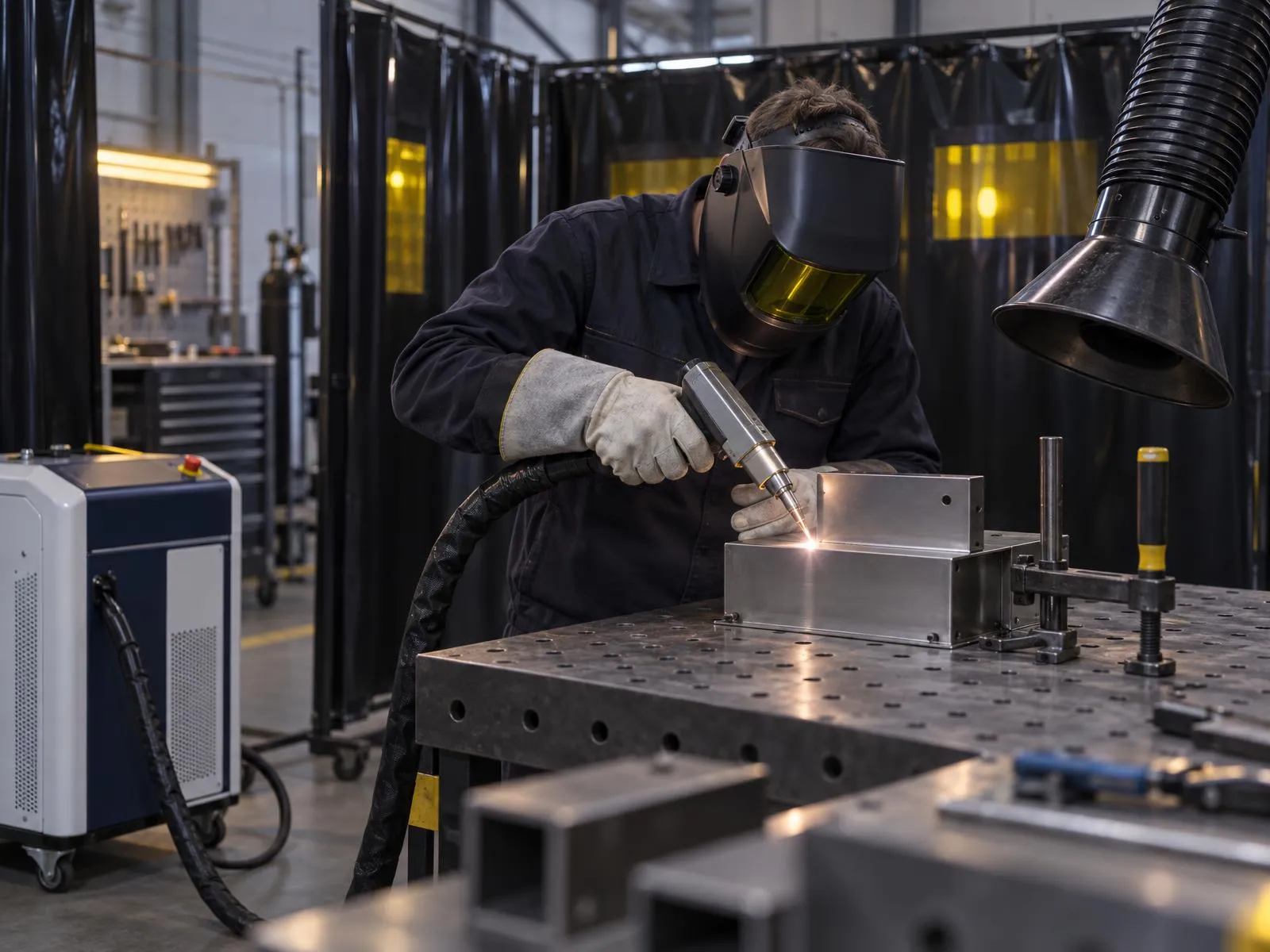
Welder wearing a laser protective visor using a handheld laser welding unit behind protective curtains
Laser welding and cleaning

Hand-guided laser devices: welding, cleaning, stripping

Handheld laser welding and cleaning units have spread within a few years. They are class 4 lasers with an invisible beam: according to METAS measurements cited by Suva, their reflections can endanger the eyes up to 49.4 m away during welding and 22 m during cleaning. Whether you are a manufacturer, importer or user, we check the conformity of the device and the safety of its use.

What you receive

  • Machinery compliance: declaration, instructions, class, labelling
  • Safety functions: key, emergency stop, anti-trigger, fibre break
  • Controlled laser area, walls and curtains, protective equipment
  • Training for welders and the laser safety officer (in French)

References

  • EN ISO 11553-2:2008
  • EN 12254*
  • Suva 67205 (2026)
Laser safety training (in French)
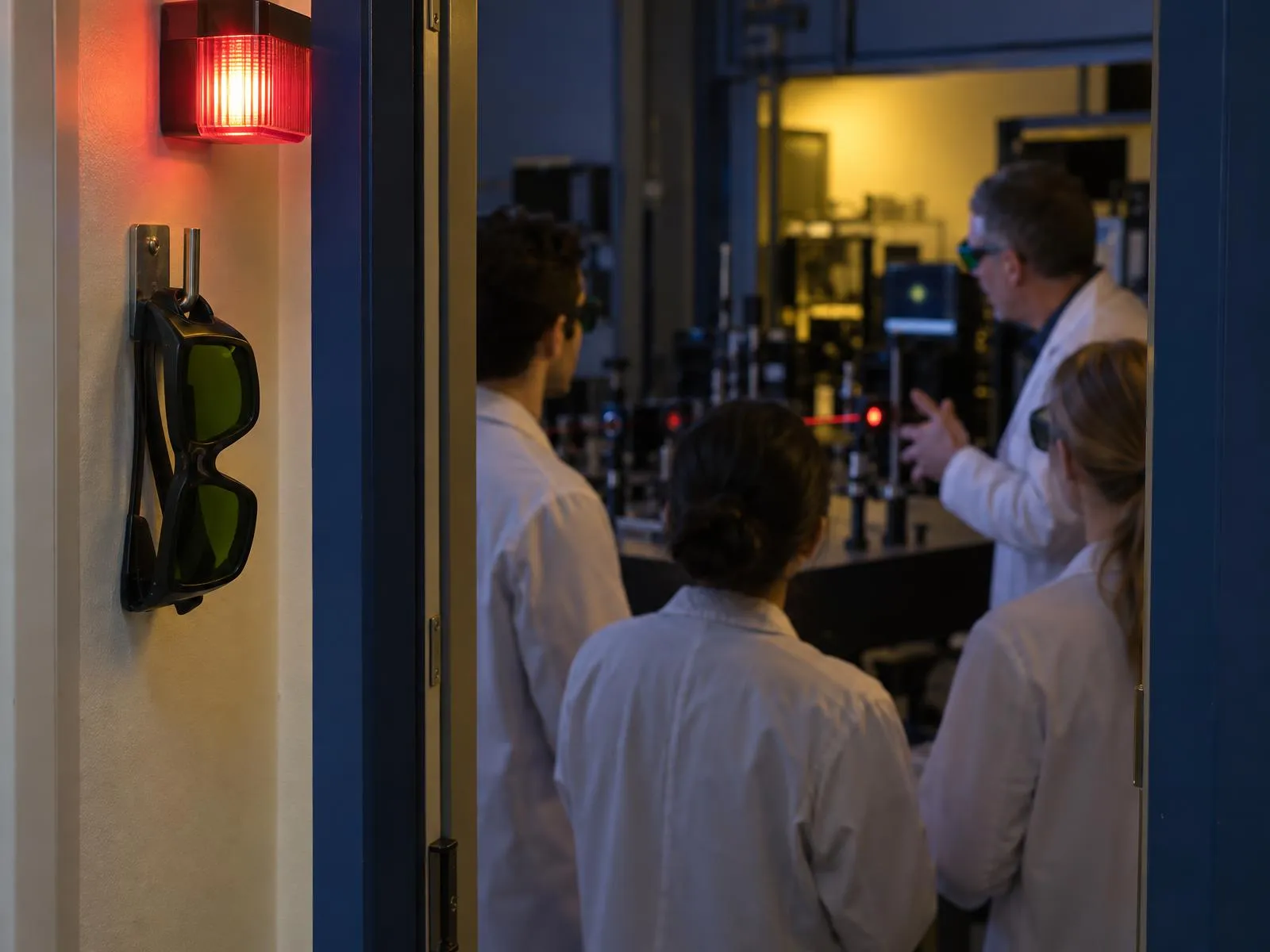
Entrance to a laser laboratory with warning light on and protective eyewear, small group of researchers in training
Research

Research laboratories and universities

Optical tables, femtosecond lasers, tunable sources: in a laboratory, beams are often open and set-ups change constantly. Class 3B and 4 lasers are among the particular hazards there: we help those in charge assess the risks, define laser areas, choose eyewear and train researchers and the laser safety officer.

What you receive

  • Risk assessment for each laser workstation (NOHD, reflections)
  • Safety concept, controlled laser areas and signage
  • Choice of laser protective eyewear
  • Training for researchers and the laser safety officer (in French)

References

  • Suva 66049
  • FCOS Directive 6508
  • IEC TR 60825-14:2022
Laser safety training (in French)
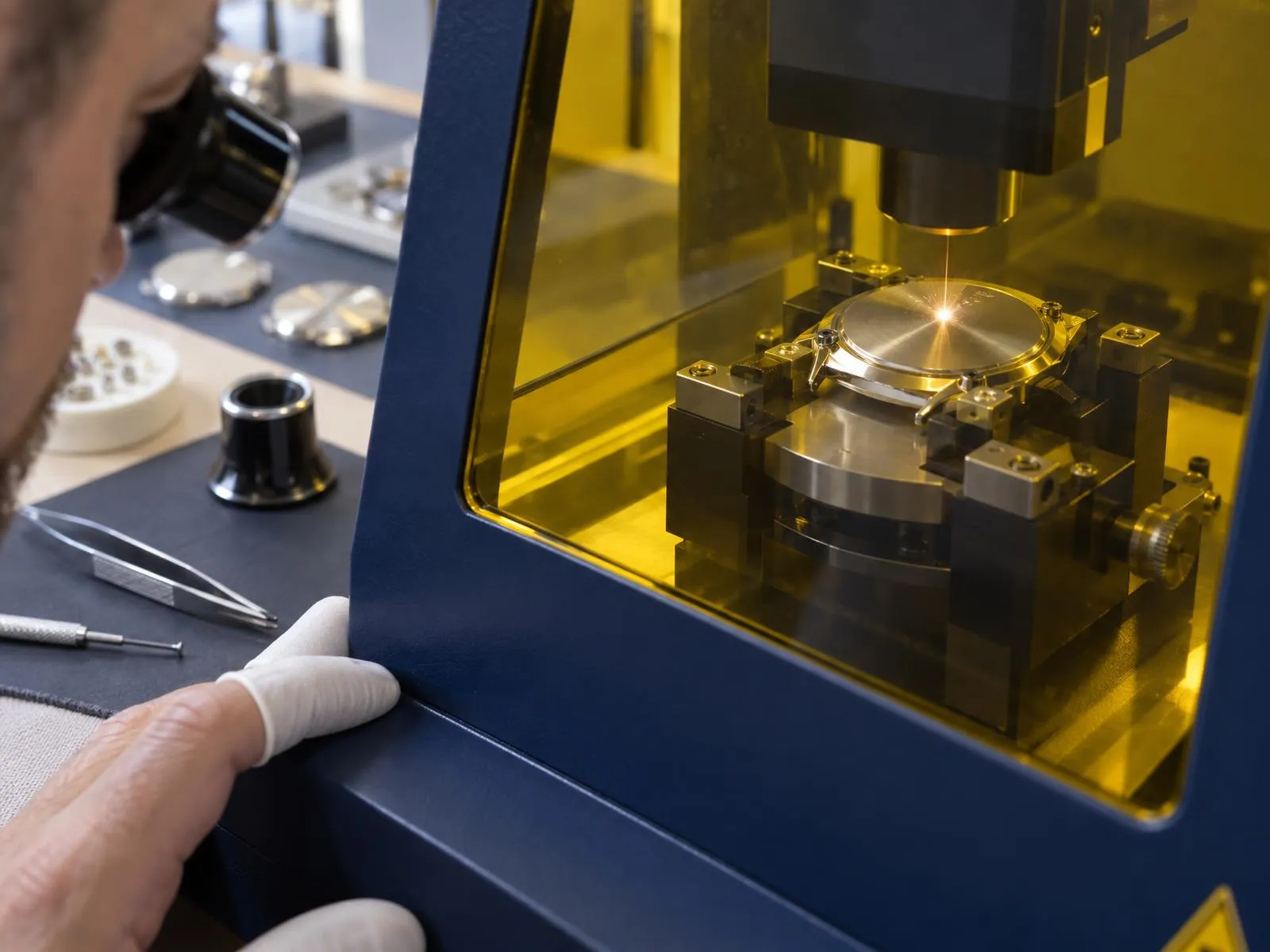
Laser engraving of a watch case back in an enclosed marking station, watchmaking workshop
Engraving and cutting

Marking, engraving and cutting machines

Watchmaking, microtechnology, medtech: marking cases, engraving dials, cutting and micromachining parts. A class 4 source enclosed in a class 1 machine: we check the laser guards, the interlocks and their performance level, in production as in maintenance, and compile the machine’s CE technical file.

What you receive

  • Risk assessment to EN ISO 12100 and EN ISO 11553-1
  • Assessment of laser guards and interlocks (PL)
  • Classification of the machine in production and maintenance
  • Technical file and EU declaration of conformity

References

  • EN ISO 11553-1:2020
  • IEC 60825-4:2022
  • EN ISO 13849-1
CE marking of machinery
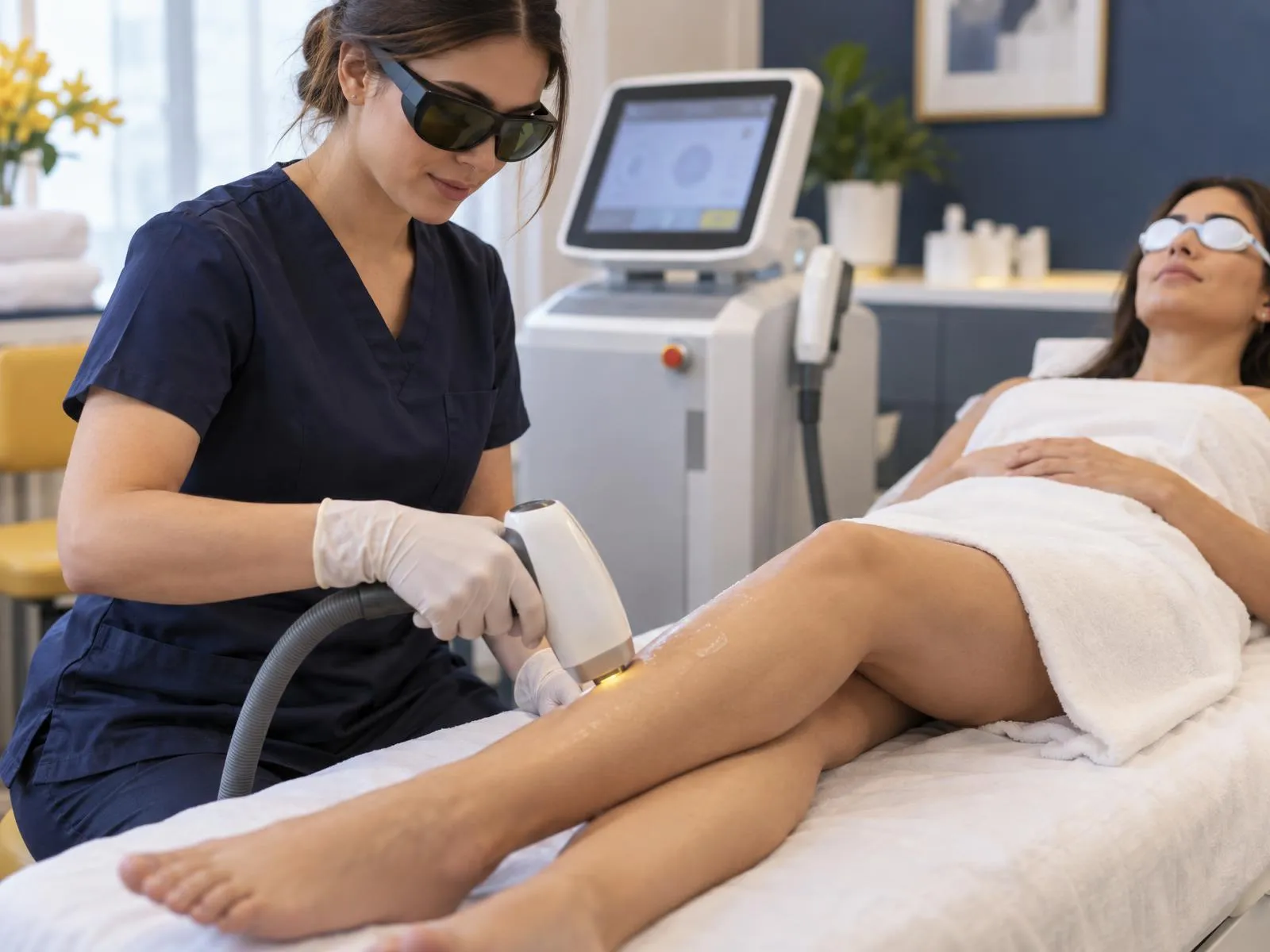
Practitioner performing laser hair removal, the client wearing protective eyewear
Aesthetics

Aesthetic devices: hair removal, tattoo removal, skin treatments

Lasers and intense pulsed light devices for hair removal, tattoo removal or skin rejuvenation fall under the Medical Device Regulation even without a medical purpose, with common specifications of their own. We support manufacturers and distributors, from laser classification to the technical file.

What you receive

  • Laser classification and risk assessment
  • Check of the applicable common specifications
  • Instructions, labelling and technical file

References

  • Regulation (EU) 2017/745, Annex XVI
  • Implementing Regulation (EU) 2022/2346
  • IEC 60601-2-22 ed. 3.1
Medical devices

Our laser services

Laser classes

Laser classes, from 1 to 4

The class depends on the accessible emission, the wavelength and the exposure duration. It sets the protective features, the labels and the precautions for the user.

  • Class 1

    Safe during use, including long-term direct viewing of the beam, even with optical instruments. Includes high-power lasers that are fully enclosed.

    Annex C.2.1
  • Class 1M

    Safe for the naked eye, but not with binoculars or a telescope for a wide, collimated beam.

    Annex C.2.2
  • Class 1C

    Laser applied to the skin or tissue (hair removal, treatments): exposure of the eyes is prevented by engineering means.

    Annex C.2.3
  • Class 2

    Visible beam, from 400 to 700 nm, safe for momentary exposure. Do not stare into the beam; may cause dazzle.

    Annex C.2.4
  • Class 2M

    Like class 2 for the naked eye, but hazardous if the beam is viewed with an optical instrument.

    Annex C.2.5
  • Class 3R

    May exceed the maximum permissible exposure under direct intrabeam viewing, with a low risk in most cases. Limit: 5 times that of class 2 (visible) or class 1 (invisible).

    Annex C.2.6
  • Class 3B

    Hazardous to the eye under direct intrabeam viewing, even briefly. Viewing a diffuse reflection is normally safe.

    Annex C.2.7
  • Class 4

    Hazardous to the eye and skin, including through diffuse reflection. Often presents a fire risk.

    Annex C.2.8

Classification

Classifying a laser product: what IEC 60825-1 says

Classification is the foundation of a laser product’s technical file: it determines the design requirements, the labels and the instructions. IEC 60825-1, edition 3 of 2014, sets the rules.

  • The manufacturer is responsible

    It is up to the manufacturer to classify its laser product correctly. Our report documents the classification and makes it verifiable.

    IEC 60825-1:2014, 4.2
  • The highest class

    The class is determined over the full range of operation, for the combination of power and wavelength that results in the highest class.

    IEC 60825-1:2014, 4.3
  • Single faults count

    The assessment takes into account any reasonably foreseeable single fault during operation, identified through a risk analysis.

    IEC 60825-1:2014, 4.3 and 5.1
  • All the requirements of the class

    A product only belongs to a class if it meets all of its requirements: protective features, labels and information for the user.

    IEC 60825-1:2014, 4.3
  • Component or final product

    A laser sold as a component to another manufacturer is not subject to part 1: the final product is classified, unless the laser still works once removed.

    IEC 60825-1:2014, clause 1
  • Exempt product

    A product that does not exceed the class 1 limit under any condition of operation, maintenance, service or failure is exempt from the other requirements.

    IEC 60825-1:2014, clause 1

Source: IEC 60825-1:2014, clauses 1, 4 and 5; in Europe, EN 60825-1:2014 + A11:2021, published in the OJEU under the Low Voltage Directive (OJ L 457 of 21.12.2021).

US market

Exporting a laser product to the United States

In the United States, laser products fall under the FDA and the performance standard 21 CFR 1040.10. With Laser Notice 56, the FDA accepts conformity with the comparable clauses of IEC 60825-1 ed. 3 in place of the corresponding requirements. The product must nevertheless be certified and identified, and many products must be reported to the FDA. We prepare these items from the same technical file as for CE marking.

Sources: FDA, Laser Notice No. 56, updated on 21.02.2023; 21 CFR 1002.1, 1010.2, 1010.3 and 1040.10

Standards

Laser safety standards

IEC 60825-1 sets the classification and requirements for all laser products. Other standards are added depending on the application: machinery, handheld devices, medical and aesthetic, guards, eyewear.

AreaStandardScope
LaserEN 60825-1:2014/A11:2021Safety of laser products: classification and requirements (IEC 60825-1:2014, edition 3)
LaserIEC 60825-2*Optical fibre communication systems
LaserIEC 60825-4:2022Laser guards (protective walls), edition 3.0
LaserIEC TS 60825-13:2026Measurements for classification of laser products
LaserIEC TR 60825-14:2022A user’s guide, edition 2
MachineryEN ISO 11553-1:2020Laser processing machines: safety requirements
MachineryEN ISO 11553-2:2008Hand-held laser processing devices: welding, cleaning
MachineryEN ISO 12100:2010General principles for design and risk assessment
MachineryEN ISO 13849-1Safety-related parts of control systems (PL)
MedicalIEC 60601-2-22 ed. 3.1Surgical, cosmetic, therapeutic and diagnostic laser equipment
ProtectionEN 12254*Screens for laser working places
ProtectionEN 207*Laser protective eyewear
ProtectionEN 208*Laser alignment eyewear
LEDIEC 62471*Photobiological safety of lamps and LEDs
ElectricalEN 61010-1 or EN IEC 62368-1Electrical safety of the device, depending on its product family

* Edition to be checked for your project. Standards remain voluntary; applying a harmonised standard whose reference is published in the Official Journal of the EU gives a presumption of conformity with the requirements it covers. For EN 60825-1, it is the combination EN 60825-1:2014 + A11:2021 that is published under the Low Voltage Directive. The harmonised status of each edition is checked in the OJEU.

Applicable legislation

Which legislation applies to a laser product?

IEC 60825-1 applies to all laser products; the European legislation that requires it depends on the product. We identify it from the first call.

  • Low voltage 2014/35/EU

    Mains-powered laser product: EN 60825-1, with its amendment A11:2021, is harmonised under the Low Voltage Directive.

    Directive 2014/35/EU; OJ L 457 of 21.12.2021
  • General product safety

    Battery-powered laser for consumers: outside the Low Voltage Directive, it falls under the General Product Safety Regulation.

    Regulation (EU) 2023/988
  • Machinery Regulation 2023/1230

    Laser marking, cutting, welding or cleaning machine: Machinery Regulation from 20 January 2027, with the EN ISO 11553 series.

    Regulation (EU) 2023/1230; IEC 60825-1, 9.3
  • Radio equipment 2014/53/EU

    Laser sensor or lidar with a radio link: laser safety is part of Article 3.1(a) of the Radio Equipment Directive (RED).

    Directive 2014/53/EU, Art. 3(1)(a)
  • Medical devices and aesthetics

    Medical laser: MDR. Laser for hair removal, tattoo removal or skin treatment: MDR Annex XVI, even without a medical purpose.

    Regulation (EU) 2017/745, Annex XVI, point 5
  • Worker exposure

    An employer using lasers assesses exposure, takes protective measures, and informs and trains workers.

    Directive 2006/25/EC, Art. 4 to 6

Our approach

Your laser’s safety in four steps

  1. Discovery call

    Your laser, its application, your markets and your timeline. 30 minutes.

  2. Analysis

    Class, applicable legislation, risks in use, measurements and tests to plan, budget and schedule.

  3. Measurement and assessment

    Classification, protective measures, laser area, electrical safety, corrections with your teams.

  4. File and training

    Report, technical file and EU declaration of conformity, training for your teams (in French).

Swiss market

Lasers in Switzerland: product, workplace and public

At work, the use of class 3B and 4 lasers is one of the particular hazards for which the employer must call on occupational safety specialists. Suva requires a laser safety officer and, for hand-guided devices, a controlled laser area and suitable protective equipment.

For the public, the V-NISSG ordinance applies: since 1 June 2021, only class 1 laser pointers may be imported, supplied or possessed. People who carry out cosmetic treatments with lasers or intense pulsed light have had to hold a certificate of competence since 1 June 2024; certain treatments are reserved for physicians.

Sources: FCOS Directive 6508, Annex 1; Suva 66049 and 67205; V-NISSG; FOPH.

Frequently asked questions

Frequently asked questions on laser safety

Does your laser raise a specific question? Ask an engineer directly.

Book a call
What rules apply to a handheld laser welding or cleaning unit?

For the manufacturer or importer: compliance with the Machinery Directive (with the Machinery Regulation from 20 January 2027), declaration of conformity, instructions in the national language stating the class, the power and the nominal ocular hazard distance (NOHD), key control, emergency stop, protection against unintended triggering and fibre break detection. For the user: laser safety officer, controlled laser area, protective walls or curtains, fume extraction and certified protective equipment.

Sources: Suva, checklist 67205 (January 2026); EN ISO 11553-2:2008

Is a laser safety officer required?

Yes, in Switzerland, for the use of class 3B and 4 lasers: they are among the particular hazards listed in FCOS Directive 6508, and Suva requires the appointment of a laser safety officer whose tasks are defined by management. The law does not specify the training: a course, instruction from the manufacturer or self-study. We train laser safety officers and users.

Sources: Suva 66049, 4.1; FCOS Directive 6508, Annex 1

Does a laboratory laser set-up need CE marking?

Generally not: a set-up designed by a laboratory for its own research is not placed on the market, and a machine specially designed for research and used temporarily in a laboratory is excluded from the Machinery Regulation. Researchers’ safety, however, remains mandatory: risk assessment, laser area, protective measures and training.

Sources: Regulation (EU) 2023/1230, Art. 2(2)(m); Suva 66049

What rules apply to laser hair removal or tattoo removal devices?

For the manufacturer: these devices fall under the Medical Device Regulation (Annex XVI) even without a medical purpose, with common specifications specific to lasers and intense pulsed light. In Switzerland, people who carry out these treatments have had to hold a certificate of competence since 1 June 2024, and certain treatments are reserved for physicians.

Sources: Regulation (EU) 2017/745, Annex XVI, point 5; Implementing Regulation (EU) 2022/2346; V-NISSG; FOPH

Who determines the class of a laser product?

The manufacturer. IEC 60825-1 assigns it responsibility for classification. Classification is based on measuring the accessible emission under all operating conditions, including any reasonably foreseeable single fault, and comparing it with the accessible emission limits of each class. We carry out these measurements and document the classification in a report.

Sources: IEC 60825-1:2014, 4.2, 4.3 and clause 5

Which laser safety standard applies in Europe?

EN 60825-1:2014 with its European amendment A11:2021, which adopts IEC 60825-1:2014 (edition 3). The combined reference has been published in the Official Journal under the Low Voltage Directive since 21 December 2021; EN 60825-1:2014 alone no longer gives a presumption of conformity since 21 June 2023.

Sources: List of harmonised standards under Directive 2014/35/EU (OJ L 457 of 21.12.2021)

What is the difference between classes 3R, 3B and 4?

Class 3R may exceed the maximum permissible exposure under direct intrabeam viewing, but with a low risk in most cases. Class 3B is hazardous to the eye under direct viewing, even briefly; diffuse reflections are normally safe. Class 4 is hazardous to the eye and skin, including through diffuse reflection, and often presents a fire risk. Design requirements increase accordingly: key control, remote interlock connector, emission indicator, beam stop.

Sources: IEC 60825-1:2014, Annex C.2 and clause 6

My product includes a laser module: do I have to classify it?

Yes, it is the final product that is classified, not the component. The module may change class depending on how it is integrated: optics, control, fault conditions. If the product does not exceed the class 1 limit under any condition, it is exempt from the other requirements of the standard, but you must be able to demonstrate this.

Sources: IEC 60825-1:2014, clause 1 and 4.3

Are laser pointers banned in Switzerland?

Yes, except in class 1. Since 1 June 2021, the import, transit, offering, supply and possession of laser pointers of classes 1M, 2, 2M, 3R, 3B and 4 have been prohibited. These rules derive from the V-NISSG ordinance, in force since 1 June 2019.

Sources: V-NISSG; FOPH, laser pointers

Which labels go on a laser product?

It depends on the class. Classes 1 and 1M: an explanatory label, which the manufacturer may instead place in the user information. From class 1C: the laser hazard symbol and an explanatory label. Depending on the class, the aperture label, information on the emitted radiation and the standard applied, and access panel labels are added. An exempt product is not subject to these requirements.

Sources: IEC 60825-1:2014, clause 1, 7.2 and 7.3

How do I sell a laser product in the United States?

Laser products there fall under the FDA and the performance standard 21 CFR 1040.10. With Laser Notice 56, the FDA accepts conformity with the comparable clauses of IEC 60825-1 ed. 3 in place of the corresponding requirements. The product must be certified and identified, and many products must be reported to the FDA.

Sources: FDA, Laser Notice No. 56 (21.02.2023); 21 CFR 1002.1, 1010.2, 1010.3 and 1040.10

Book a call

Tell us about your laser

Book a 30-minute slot with an engineer directly. No back-and-forth by email: you choose the time, we prepare the call.

Choose a time slot

Contact details

Address
Säfeli Sàrl
Route d'Englisberg 3
1763 Granges-Paccot
Languages
French, German, English
Book a call