Testing laboratory and consultancy · Granges-Paccot

Book a call

Testing · EMC

Electromagnetic compatibility testing

Your product must neither disturb nearby equipment nor be disturbed by it. Conducted and radiated emissions, harmonics, electrostatic discharge, radio-frequency fields, mains transients: we carry out EMC tests according to your product’s standard, and pre-compliance tests on a prototype to find the source of an exceedance. You receive a test report ready for your technical documentation.

No third party required by the EMC Directive
Module A
Requirements: emissions and immunity
2
Find the source of an exceedance
Pre-compliance
For your technical documentation
Report

Product standards

Your product's EMC standard

The product standard sets the tests, levels and performance criteria. Where there is no dedicated standard, the generic standards apply according to the environment of use.

  • Generic standards

    When no product standard exists: immunity and emissions, for residential or industrial environments.

    IEC 61000-6-1 to 6-4
  • IT and multimedia

    Computers, networks, audio, video: Class A or Class B emissions, and immunity.

    EN 55032 and EN 55035
  • Household appliances and tools

    Household appliances, electric tools and similar apparatus: emissions and immunity.

    EN 55014-1 and EN 55014-2
  • Industrial, scientific, medical

    ISM equipment, including equipment that uses radio-frequency energy to heat or treat material.

    EN 55011
  • Laboratory and measurement

    Electrical equipment for measurement, control and laboratory use: emissions and immunity in a single standard.

    EN 61326-1
  • Medical devices

    Medical electrical equipment: emissions and immunity, with test levels linked to the environment of use.

    IEC 60601-1-2
  • Radio equipment

    The EMC of a radio product: a common part and a part specific to each technology.

    EN 301 489
  • Mains supply

    Harmonic currents and flicker from equipment connected to the public low-voltage supply.

    IEC 61000-3-2 and 61000-3-3

Our testing

Emissions, immunity and pre-compliance

Your product standard sets the tests, levels and criteria. The methods come from the IEC 61000-4 and CISPR 16 basic standards.

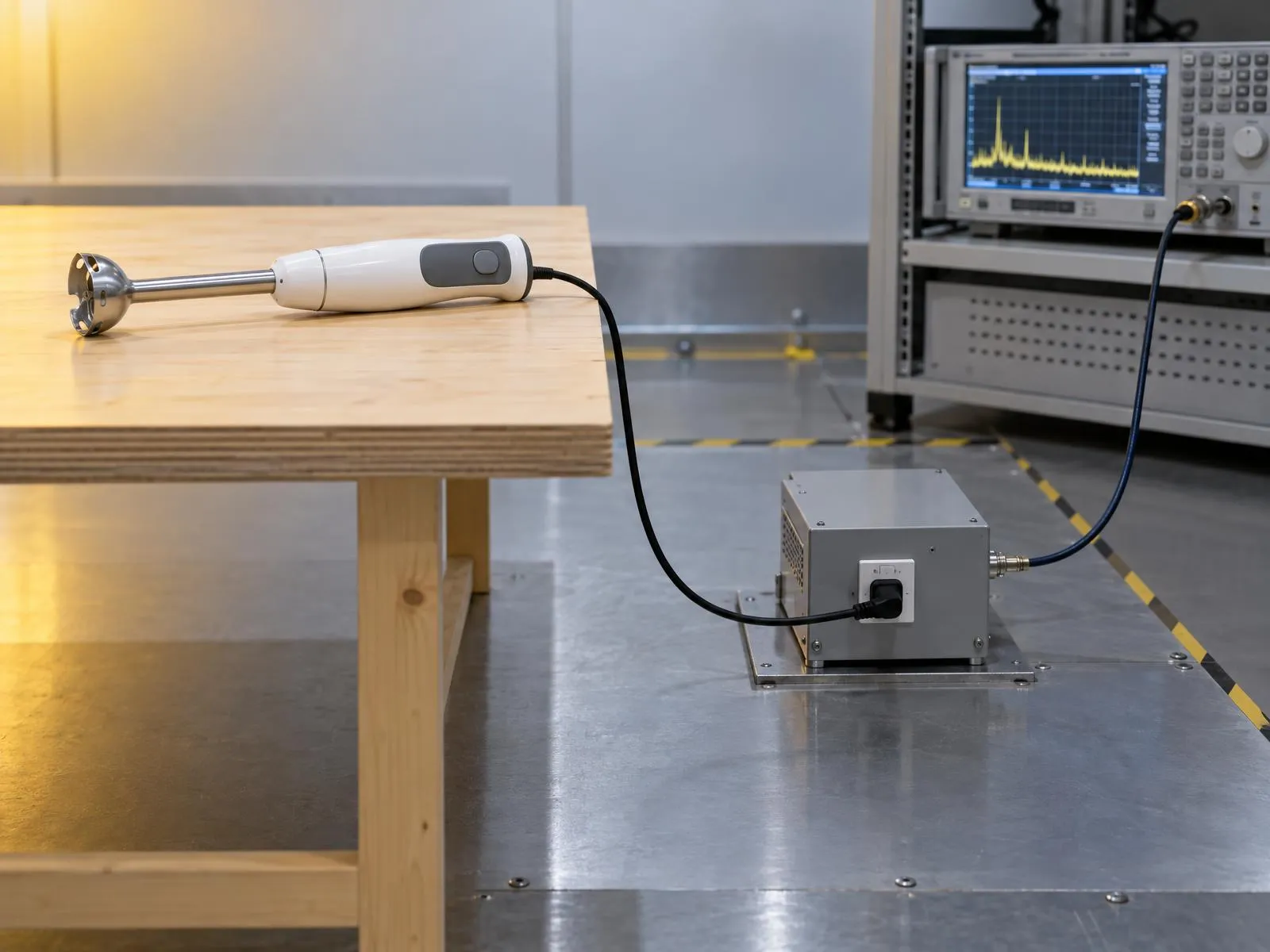
Hand blender on a test table, connected to an artificial mains network and a measuring receiver
Conducted emissions

Conducted emissions

The disturbances your product sends back along its cables, from 150 kHz to 30 MHz: we measure them at the mains port through an artificial mains network, with quasi-peak and average detectors, and compare them with the limits of the target class.

What you receive

  • Power port
  • Quasi-peak and average detectors
  • Comparison with Class A or B limits

References

  • EN 55032, Annex A
  • CISPR 16-2-1
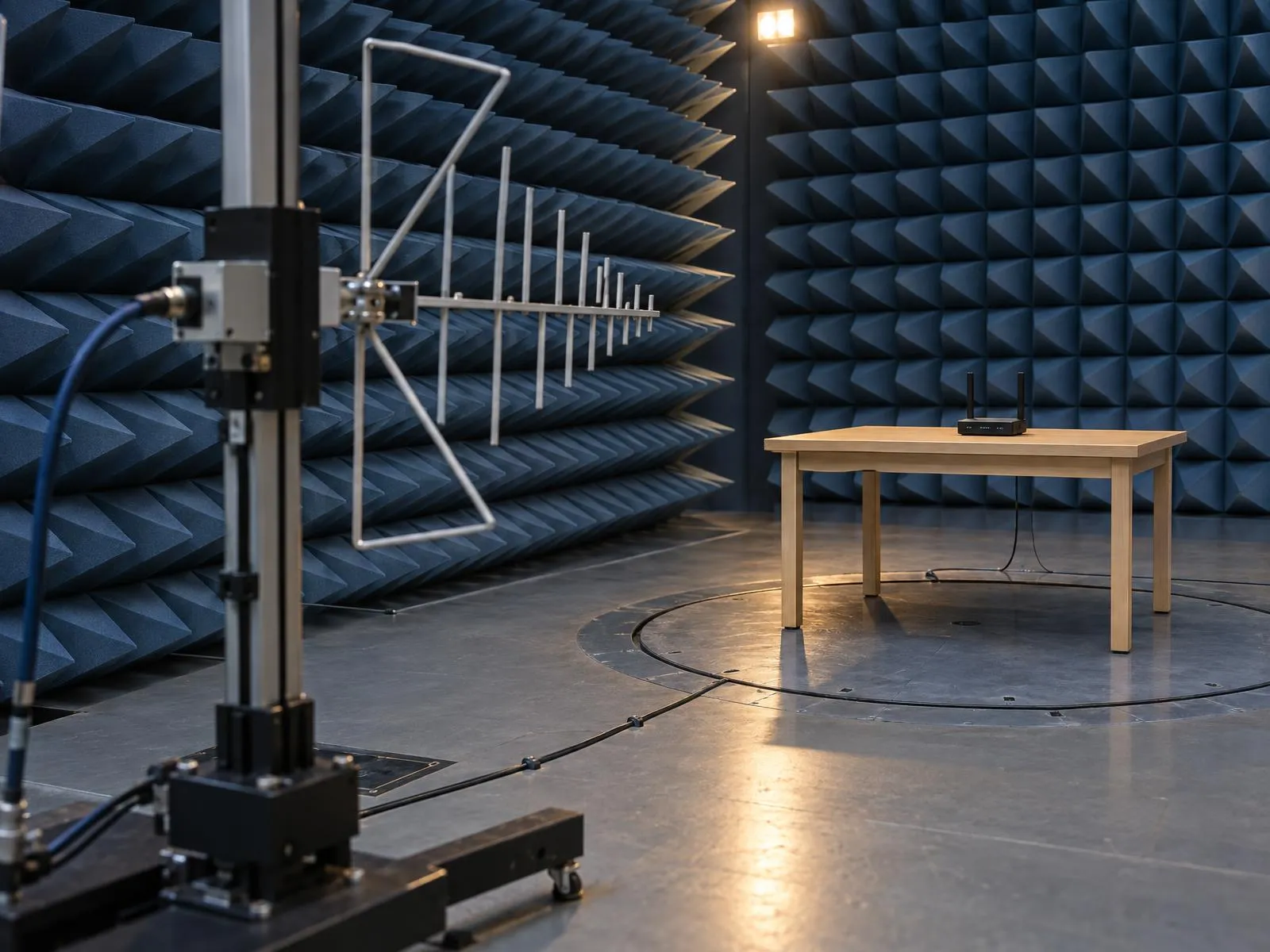
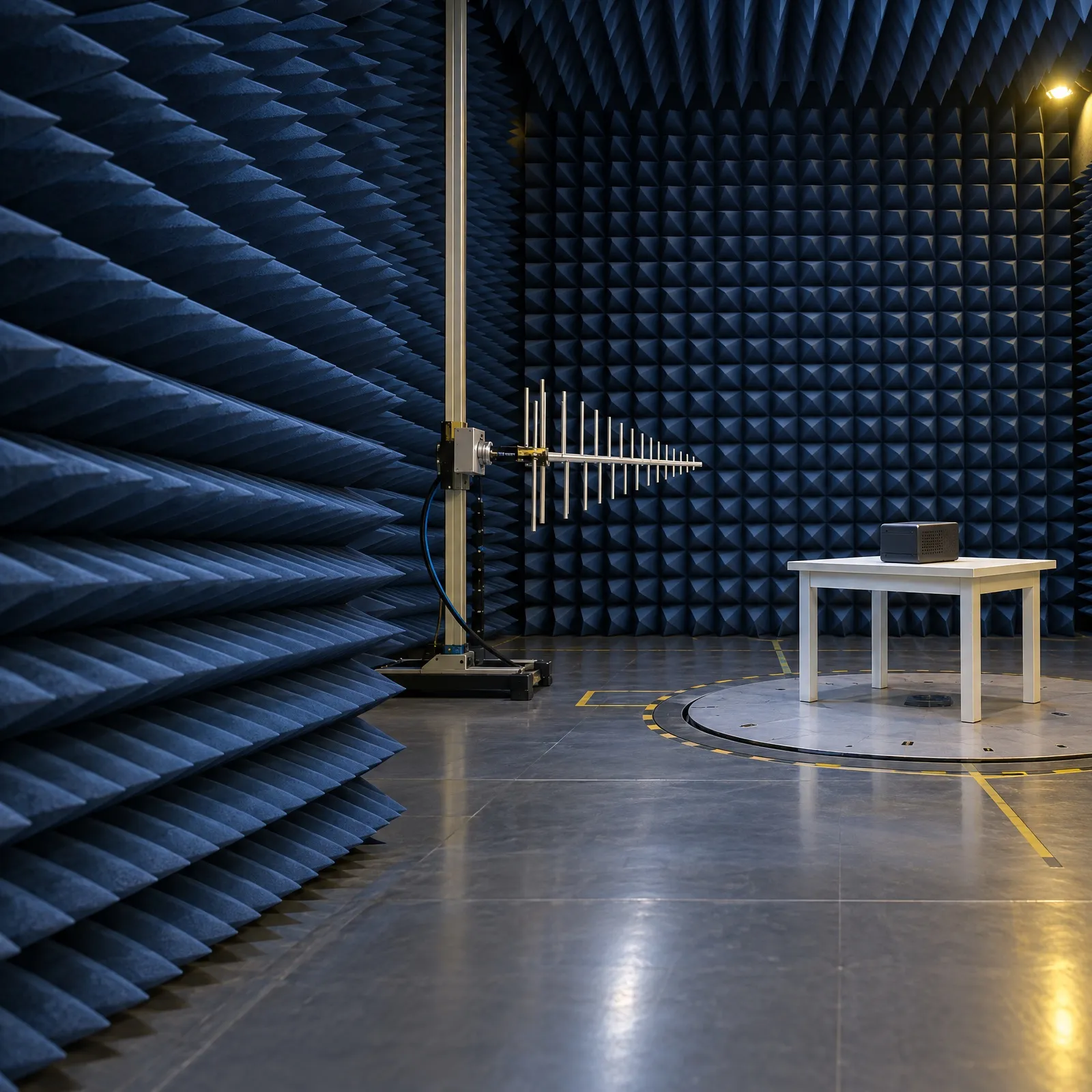
Semi-anechoic chamber with a measuring antenna facing a product on a turntable
Radiated emissions

Radiated emissions

The field your product radiates into space: from 30 MHz to 1 GHz in a semi-anechoic chamber or on an open-area test site, at 3 or 10 m, with the product rotated and the antenna height varied, then above 1 GHz depending on the highest frequency in the product.

What you receive

  • 30 MHz to 1 GHz
  • Above 1 GHz
  • Highest-emission configuration

References

  • EN 55032, Annex A
  • CISPR 16-1-4 (test sites)
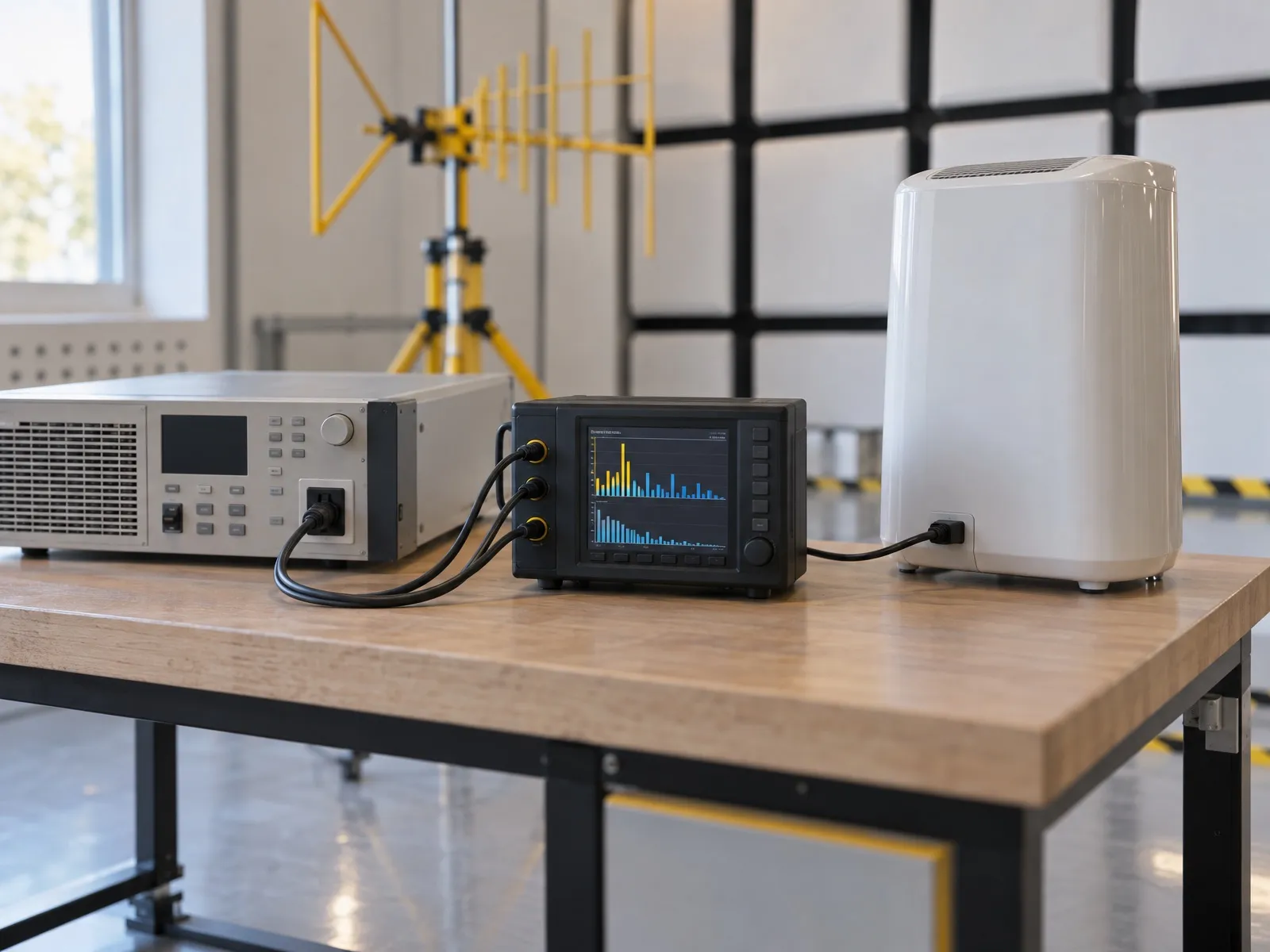
Household appliance connected to a power source and a power analyser displaying a harmonic spectrum
Harmonics and flicker

Harmonics and flicker

Equipment connected to the public supply must neither pollute it with harmonics nor cause voltage fluctuations visible in the lighting. We measure the harmonic currents drawn and the flicker, up to 16 A per phase, and above that with the dedicated standards.

What you receive

  • Harmonic currents
  • Flicker
  • Equipment class

References

  • IEC 61000-3-2
  • IEC 61000-3-3
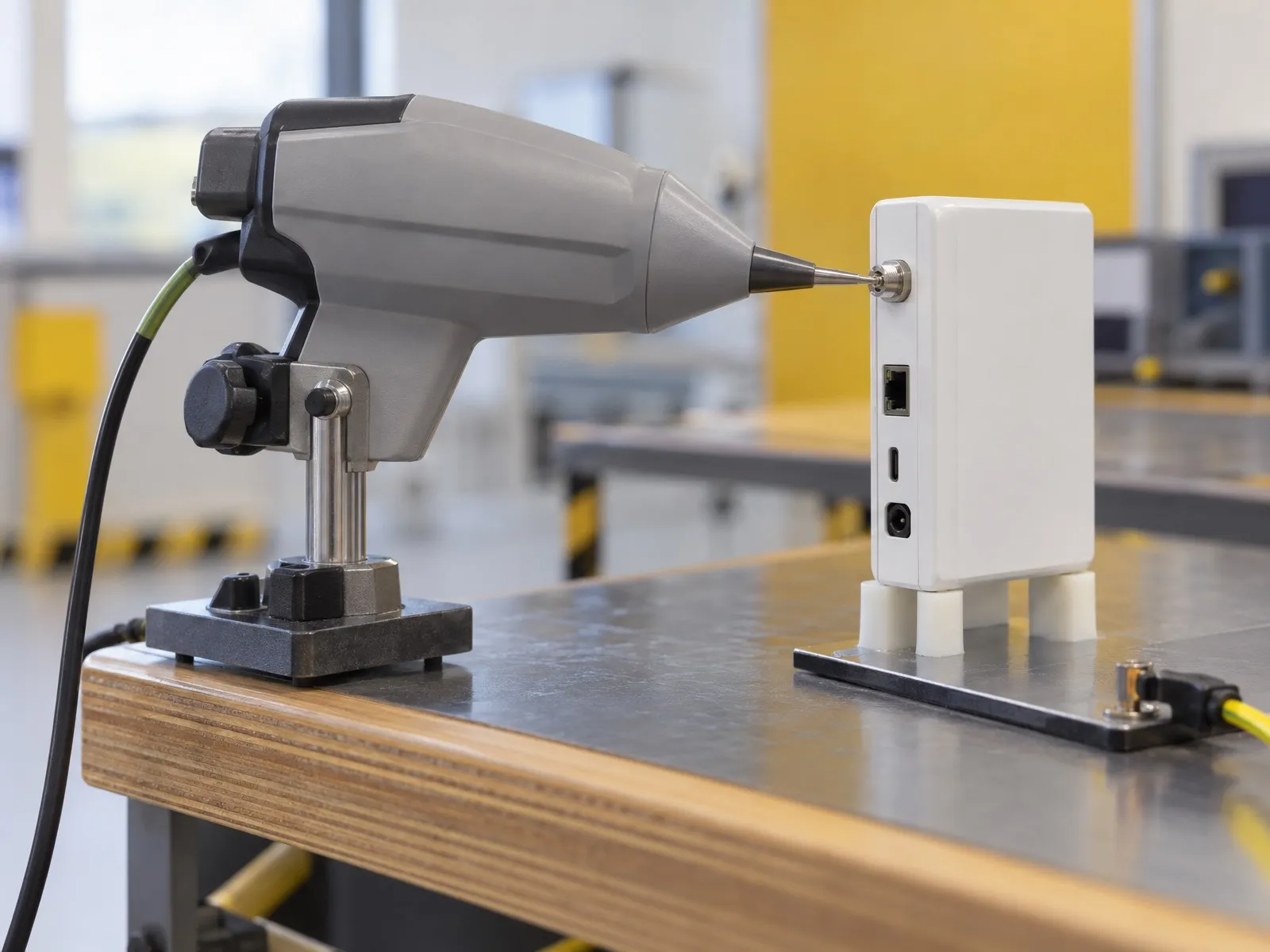
Electrostatic discharge gun applied to the enclosure of a small electronic device
Electrostatic discharge

Electrostatic discharge

A charged user touches your product: we reproduce the discharge with an ESD gun, by contact on conductive parts, through air on insulating surfaces and indirectly on the coupling planes. Levels go up to 8 kV contact and 15 kV air; the product standard sets the one to apply.

What you receive

  • Contact and air discharges
  • Indirect discharges
  • Performance criteria A, B, C

References

  • IEC 61000-4-2
  • EN 55035
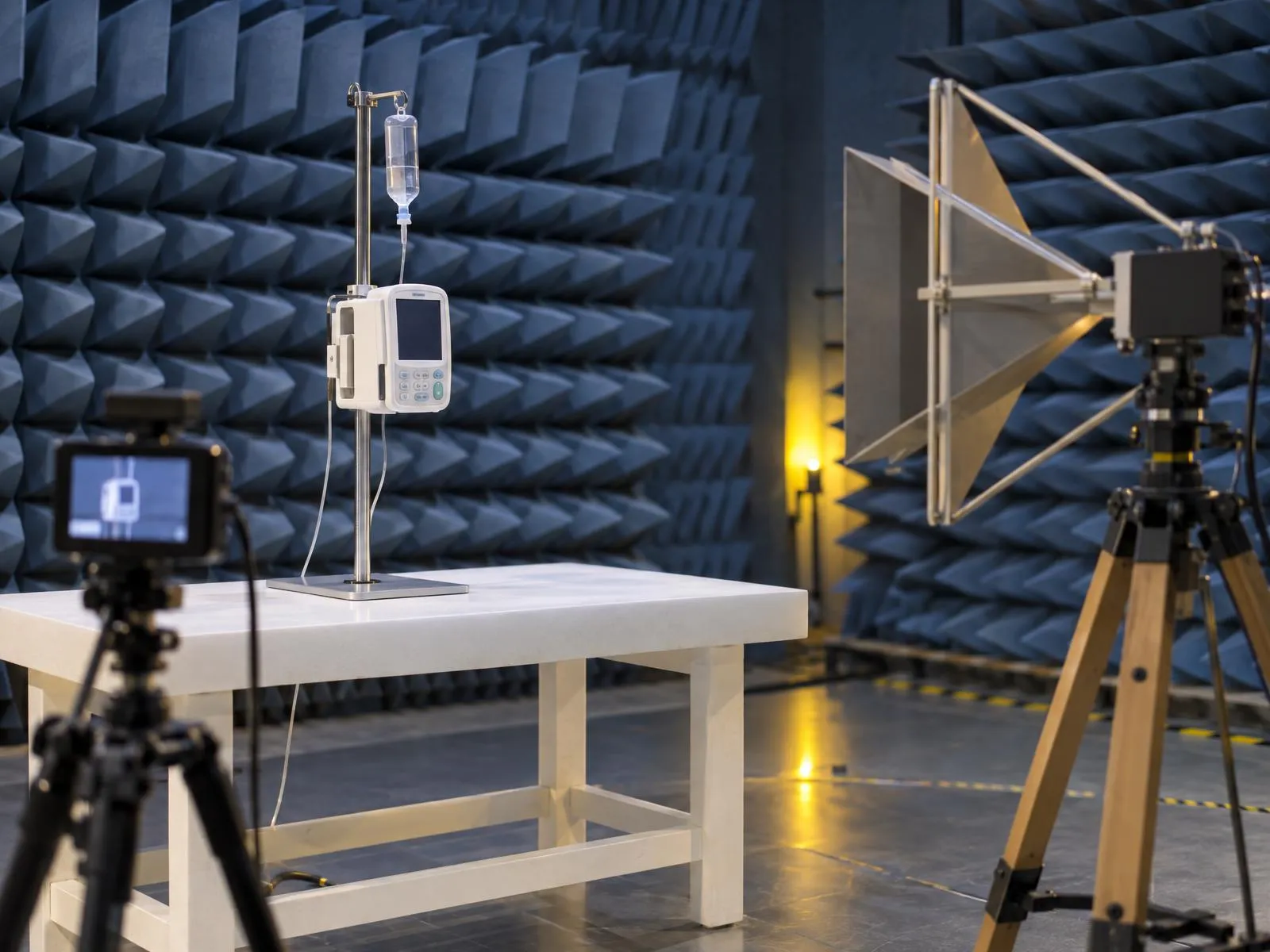
Infusion pump in an anechoic chamber, facing a horn antenna and monitored by a camera
RF immunity

Immunity to radiated and conducted fields

Phones, transmitters, radios: we expose your product to a modulated radio-frequency field, from 1 to 30 V/m depending on the level, in an absorber-lined chamber, and inject conducted disturbances into its cables from 150 kHz to 80 MHz. The product is monitored continuously throughout the test.

What you receive

  • Radiated immunity
  • Conducted immunity
  • 50 Hz magnetic field

References

  • IEC 61000-4-3
  • IEC 61000-4-6
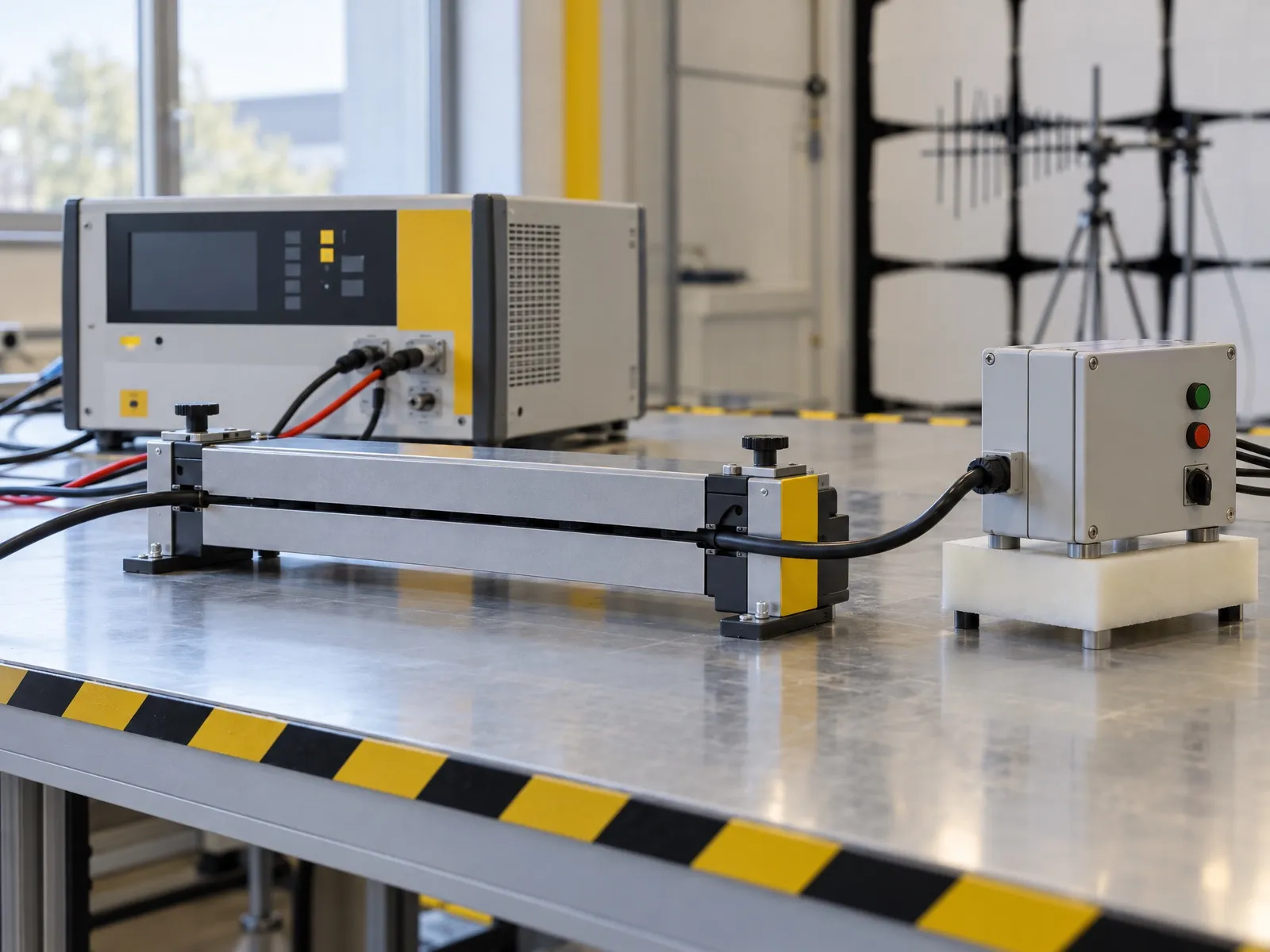
Transient generator connected to a coupling clamp through which the cable of an electronic enclosure passes
Mains transients

Transients, surges and voltage dips

What the mains supply does to your product: electrical fast transient bursts when inductive loads are switched off, surges caused by lightning or switching, voltage dips and short interruptions. The levels depend on the intended environment, residential or industrial.

What you receive

  • Electrical fast transients (burst)
  • Surges
  • Voltage dips and interruptions

References

  • IEC 61000-4-4 and 61000-4-5
  • IEC 61000-4-11
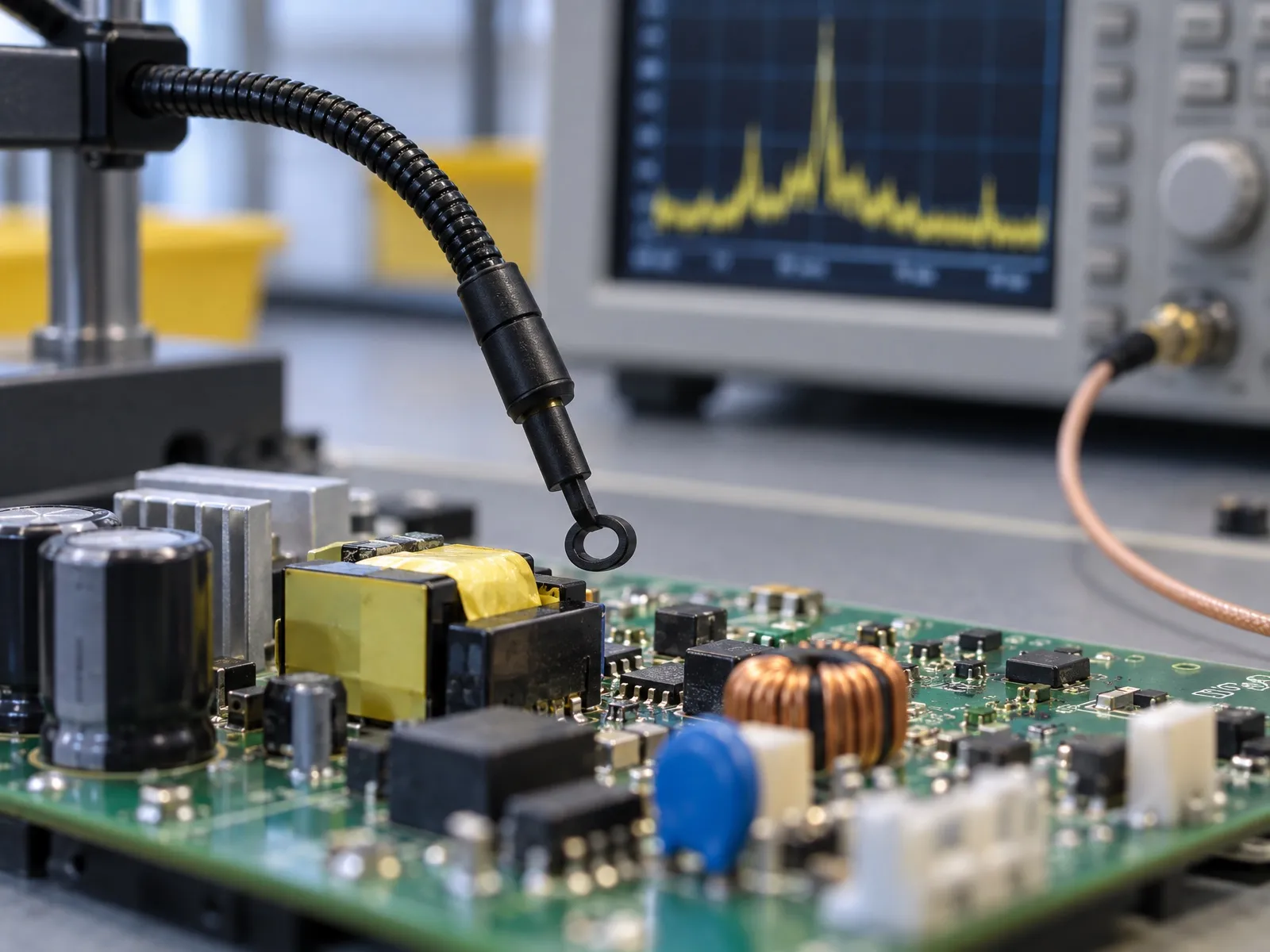
Near-field probe above a power supply printed circuit board, connected to a spectrum analyser
Pre-compliance

Pre-compliance testing and troubleshooting

Before the final tests, or after a failure: near-field probes on the printed circuit board, pre-compliance measurements, identification of the source, then targeted countermeasures such as filtering, ferrites, layout or shielding. The aim is to go into the final tests with a product that passes.

What you receive

  • Pre-compliance measurements
  • Source identification
  • Countermeasures and verification

References

  • According to the product standard

Also

Regulation

The regulatory framework

The EMC Directive covers most electrical and electronic equipment. Radio equipment and medical devices follow their own legislation, with comparable requirements.

  • Two requirements

    Do not generate disturbances that affect other equipment, and withstand those of the intended environment without unacceptable degradation.

    Directive 2014/30/EU, Art. 6 and Annex I
  • No third party required

    The manufacturer may assess conformity itself (Module A). EU-type examination by a notified body remains an option, never an obligation.

    Art. 14, Annexes II and III; EMC Guide, § 4.3.1
  • Technical documentation

    EMC assessment in all representative configurations, risk analysis, test reports, kept for 10 years.

    Directive 2014/30/EU, Annex II
  • Radio equipment

    Excluded from the EMC Directive, it must meet the directive’s requirements through the Radio Equipment Directive (RED).

    Directive 2014/53/EU, Article 3(1)(b)
  • Medical devices

    The MDR sets its own requirements: reduce the risk of interference and ensure an appropriate level of immunity.

    Regulation (EU) 2017/745, Annex I, 18.5 and 18.6
  • Fixed installations

    Neither CE marking nor EU declaration of conformity for the installation, but installation according to good engineering practices, documented.

    Directive 2014/30/EU, Art. 19; EMC Guide, Chapter 5

Sources: Directive 2014/30/EU; Commission EMC Guide (2018); Directive 2014/53/EU; Regulation (EU) 2017/745.

Standards

Editions and status in the Official Journal

In EMC, the gap between the editions cited in the Official Journal and the latest IEC editions is particularly wide. We check both for every project.

FieldStandardScope
MultimediaEN 55032:2015+A11:2020Emissions, cited in the OJEU; CISPR 32 edition 2.1
MultimediaEN 55035:2017+A11:2020Immunity, cited in the OJEU; CISPR 35:2016
HouseholdEN 55014-1:2017+A11:2020Emissions, cited in the OJEU; CISPR 14-1 edition 7 (2020)
HouseholdEN 55014-2:1997+A2:2008Immunity, edition cited in the OJEU
HouseholdEN IEC 55014-2:2021Published, not cited in the OJEU
ISMEN 55011:2016+A1:2017+A11:2020Cited in the OJEU; CISPR 11 edition 7 (2024)
GenericEN 61000-6-1:2007 and 6-2:2005Immunity, editions cited in the OJEU; IEC 61000-6-1 and 6-2 edition 3 (2016)
GenericEN 61000-6-3 and 6-4:2007+A1:2011Emissions, editions cited in the OJEU; IEC 61000-6-3 edition 4 (2026)
GenericEN IEC 61000-6-4:2019Published, not cited in the OJEU
LaboratoryEN 61326-1:2013Cited in the OJEU; IEC 61326-1 edition 3 (2020)
MainsEN 61000-3-2:2014 and 3-3:2013Harmonics and flicker, editions cited in the OJEU
MethodIEC 61000-4-2:2025Electrostatic discharge, edition 3; the product standard sets the edition to apply
MethodCISPR 16Apparatus, test sites and methods for measuring radio disturbance

Status as of 2 October 2026: Implementing Decision (EU) 2019/1326, as last amended by Decision (EU) 2022/910 of June 2022, to be checked for any later publication. The IEC 61000-4 and CISPR 16 basic standards are not harmonised as such: the product standard sets the edition to apply.

Our approach

Your testing in four steps

  1. Discovery call

    Your product, its standard, your markets and your schedule. 30 minutes.

  2. Test plan

    Tests, levels, configurations, samples, lead times and budget.

  3. Testing

    Pre-compliance tests on a prototype if useful, then tests on the representative sample.

  4. Report

    Results, deviations and recommendations, for your technical documentation.

Swiss market

EMC in Switzerland

The Swiss EMC Ordinance (VEMV) adopts the requirements of the EMC Directive: the same essential requirements, the same technical standards, designated by OFCOM, and the same choice between internal production control and type examination. The Swiss CH mark or the CE marking is permitted; the declaration of conformity and the technical documentation, including test reports, are mandatory and must be kept for 10 years.

The Federal Office of Communications (OFCOM) carries out spot-check market surveillance: it can request the documentation, have tests carried out, at the expense of the responsible party in the event of non-conformity, and order measures up to and including a recall. The Switzerland–EU Mutual Recognition Agreement (MRA) avoids duplication for manufacturers established in either.

Sources: VEMV, SR 734.5 (status as of 1 January 2022), Art. 4 to 13 and 24 to 27; BBl 2022 1503; MRA, SR 0.946.526.81, Annex 1, Chapter 9.

Frequently asked questions

Frequently asked questions about EMC testing

Does your product raise a specific question? Ask an engineer directly.

Book a call
Class A or Class B?

Class B is intended for residential environments, with stricter emission limits; Class A for other environments, such as industry. Equipment that does not meet the residential limits must state this clearly, where applicable also on the packaging. We help you choose the class according to your customers and places of use.

Sources: EN 55032:2015, clause 4; Directive 2014/30/EU, Art. 18

Do I need a notified body or an accredited laboratory?

Not for the EMC Directive. The manufacturer may assess the conformity of its product itself (Module A); EU-type examination by a notified body is optional. The Commission's guide states that the directive does not require the involvement of any third party. Some customers or markets do, however, require accredited reports: we flag this in the test plan and support you if that is the case.

Sources: Directive 2014/30/EU, Art. 14, Annexes II and III; Commission EMC Guide (2018), § 4.3.1

Why carry out EMC pre-compliance tests?

Because EMC problems almost always originate in the design: PCB layout, switch-mode power supply, clocks, cables, grounding. On a prototype, a pre-compliance measurement and a few near-field probes are often enough to find the source of an exceedance. Fixing it at this stage costs far less than after industrialisation.

Are the harmonised EMC standards up to date?

Not all of them. The list of harmonised standards under the EMC Directive has not been amended since June 2022, and several cited references are old, such as EN 61000-6-1:2007 or EN 61326-1:2013, while the IEC has published more recent editions. Only references cited in the Official Journal give presumption of conformity: for each project, we check which edition to apply and what the more recent ones change.

Sources: Directive 2014/30/EU, Art. 13; Implementing Decision (EU) 2019/1326, as last amended by Decision (EU) 2022/910

My product contains a radio module: which EMC standards apply?

A radio product falls under the Radio Equipment Directive (RED), whose EMC requirement refers to the EMC Directive. EN 301 489 then applies: its common Part 1 and the technology-specific part, for example Part 17 for Wi-Fi and Bluetooth. Only the specific parts are cited in the Official Journal under the RED. The non-radio part of the product must also be assessed.

Sources: Directive 2014/53/EU, Article 3(1)(b); Implementing Decision (EU) 2022/2191; ETSI EG 203 367, 5.1

My device is very simple: is it covered?

Only inherently benign equipment is excluded: equipment that cannot generate disturbing emissions and that operates without unacceptable degradation in the presence of normal disturbances. As soon as a product contains electronics, such as a microcontroller or a switch-mode power supply, it is almost always covered. We assess borderline cases with you.

Sources: Directive 2014/30/EU, Article 2(2)(d)

Book a call

Tell us about your product

Book a 30-minute slot with an engineer directly. No back-and-forth by email: you choose the time, we prepare the call.

Choose a time slot

Contact details

Address
Säfeli Sàrl
Route d'Englisberg 3
1763 Granges-Paccot
Languages
French, German, English
Book a call